


How to use it
- Tap your child's age.
- Read which classes, method books and apps their makers say are made for that age; each line links to the maker's own page.
- Print the free sticker chart for the first weeks of practice.
Is your child ready?
Hoffman Academy, which makes online piano lessons for children, looks for three things before lessons start: being able to focus for short periods, some interest in music, and enough hand coordination to move the fingers one at a time. It finds those come together between 6 and 7 for most children, with some ready earlier and some later.
Lesson books start a little younger. Faber writes My First Piano Adventure for young beginners of 5 to 6, Kjos writes Bastien's Piano for the Young Beginner for the same ages, and Alfred writes its Prep Course for children five and up, with a young beginner's shorter attention span and smaller hands in mind. Yamaha's music school starts its Junior Music Course at 4 and 5, with a parent taking part.
Younger than five
Hoffman Academy notes that music teachers often recommend 6 to 8 for formal lessons, and that formal lessons can be too much for very young children unless the teacher specializes in that age. For 3 to 5 year olds it suggests letting the child set the pace, keeping sessions short and full of games, and watching lessons together. Until the fingers can move one at a time, it suggests playing with the fingertips held together in a "chicken head" shape. Musikgarten's Cycle of Seasons is a music class for preschoolers of 3 to 5, before the piano.
A teacher, a class or an app
Faber, Kjos and Alfred each publish a series of lesson books that a child works through level by level; Kjos pairs each Bastien Piano Basics book with Theory, Performance, Technic and sight-reading books. Our guide to piano books for beginners compares the methods for children and adults.
A group class puts a child at the keyboard with other children. Yamaha's music school runs its Junior Music Course for 4 and 5 year olds over two years, one class a week, with a parent taking part; its Young Musicians Course is for 6 to 8 year olds, with a parent's part optional. Musikgarten's Music Makers: At the Keyboard teaches group piano from age 6.
An app can teach at home, between lessons or instead of them. Simply Piano gives children of 4 to 10 their own start, with songs they know and more videos; Skoove is made for children of 7 and up as well as adults; Playground Sessions recommends itself from 7; and Pianote's lessons can start a child as young as 4 with a parent nearby, though members must be 16 or older, so a parent signs up. What each app costs, and how it hears the piano, is in our guide to piano learning apps.
Choosing a teacher
The Music Teachers National Association (MTNA) suggests asking friends, local teacher groups, music stores and schools for names, meeting a teacher before you commit, and asking to attend a recital of their students. Its questions for that meeting cover:
- their teaching experience, and the age groups they teach;
- how much practice time they ask for each day;
- what they expect of their students, and of the parents.
The Suzuki Association of the Americas suggests watching a teacher's lessons before you start, and noticing how the teacher works with the child and with the parent. MTNA's certified teachers, Nationally Certified Teachers of Music (NCTM), are listed in its Find a Teacher directory, and the Suzuki Association has its own teacher search.
Your part as a parent
MTNA calls a parent's support vital, whether or not you know anything about music: listen to your child play, give them practice time on a good instrument, and celebrate what they achieve. In the Suzuki method, a parent goes to the lessons and acts as the home teacher and practice partner during the week. Yamaha's Junior Music Course asks a parent to take part, and Pianote suggests a parent stays nearby so a young child keeps focused.
Practice at home
How much to practice is a question for your child's teacher; it's one of MTNA's questions above. For 3 to 5 year olds, Hoffman Academy suggests short sessions that switch between activities, with games, and no rule of sitting at the piano for thirty minutes: forcing too much structure at that age, it says, can make a child resist learning later.
For first songs at home, our piano notes chart names every key, with a part on key stickers, our piano fingering chart numbers the fingers 1 to 5, and our easy piano songs start with tunes for the right hand alone.
The free sticker chart
Two pages to print, in US Letter and A4. The first is a week's chart, with a box a day for a sticker, what was played, and a song to aim for. The second, "My songs", is a ladder of twelve songs to fill in, with a sticker for each one played all the way through.
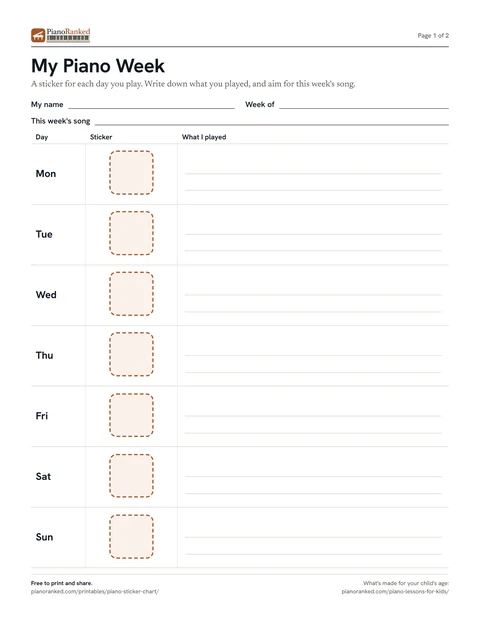
The piano sticker chart
A week's chart and a ladder of twelve songs, with a box for a sticker each time.
What to play it on
Once lessons start, our guide to keyboards for kids suggests full-size keys, so what a child learns carries over to a teacher's piano. Its first pick is the Yamaha
View the PSR-E383 on Amazon (opens in a new tab)
For a first piano with weighted keys and all 88 notes, the Yamaha
View the Yamaha P-225 on Amazon (opens in a new tab)
Before lessons, while hands are small, the same keyboards guide suggests mini keys, such as Casio's
FAQ
Can a 5 year old learn to play the piano?
Yes. Faber's My First Piano Adventure and Kjos's Piano for the Young Beginner are both written for ages 5 to 6, and Alfred's Prep Course for children five and up. Hoffman Academy says most children are ready between 6 and 7, once they can focus for a short while and move their fingers one at a time.
What age should a child start piano lessons?
It depends on the child, Hoffman Academy says: most are ready between 6 and 7, some earlier and some later. Method books start at 5 (Faber, Kjos, Alfred), Yamaha's music school starts its Junior Music Course at 4 with a parent taking part, and Simply Piano's children's start begins at 4.
Can a 3 year old start piano lessons?
Formal lessons can be too much for very young children, Hoffman Academy says, unless the teacher specializes in that age; for 3 to 5 year olds it suggests short, playful sessions instead. Musikgarten's Cycle of Seasons is a music class for preschoolers of 3 to 5, and Yamaha's US music school starts at 4.
How long should a young child practice piano?
Ask the teacher: MTNA lists daily practice time among the questions to ask before lessons start. For 3 to 5 year olds, Hoffman Academy suggests short sessions that switch between activities, and advises against making a young child sit at the piano for thirty minutes.
You've reached the end
You now know what's made for your child's age, and what to ask a teacher.
Sources
- Faber Piano Adventures: My First Piano Adventure
- Faber Piano Adventures: Basic Piano Adventures
- Faber Piano Adventures: Accelerated Piano Adventures
- Kjos: Bastien, Piano for the Young Beginner, Primer A
- Kjos: Bastien Piano Basics, Piano Primer
- Kjos: the Bastien Piano Basics method
- Alfred: Alfred's Basic Piano Prep Course overview
- Yamaha Music School (USA): Junior Music Course
- Yamaha Music School (USA): Young Musicians Course
- Musikgarten: Cycle of Seasons for preschoolers
- Musikgarten: Music Makers, At the Keyboard
- Hoffman Academy: What is the best age to start piano lessons?
- Hoffman Academy: Piano lessons for toddlers and preschoolers
- Simply Piano help: Is the app experience different for children?
- Skoove help: Who can use Skoove?
- Playground Sessions support: Is it a good program for complete beginners?
- Musora (Pianote) help: Will the lessons work for my child?
- Music Teachers National Association: Choosing a music teacher
- Suzuki Association of the Americas: How to choose a teacher