


How to use it
- Pick 15, 30 or 45 minutes, and today's scale.
- Tap Start. The timer runs each part in turn and chimes when it's time to move on; Pause, Previous part, Next part and Start over work at any moment.
- Note what you played in the free practice log, so you know where to start next time.
Why four parts, and where the minutes come from
Jerry Kovarsky's plan, from his Well-Rounded Keyboardist column on Yamaha's site, starts with a few minutes of warm-up before you even touch the keys. He keeps scales to no more than about 20% of the time, gives a new piece about 30%, and leaves the rest for other goals, with some time to play freely for fun.
Our three routines are our own plan, built on his: a few minutes of warm-up, about a fifth of the time for one scale and the same for something you enjoy, and the rest, about half, for your piece. At 30 minutes that's 3, 6, 15 and 6 minutes.
Roland says just 15 minutes a day does more for muscle memory than a weekly three-hour session, and Yamaha's tips ask for at least 20 minutes a day, split into 20-minute sessions if you have longer. What those minutes add up to is in our guide to how long it takes to learn piano.
Breaks and short sessions
Kovarsky also suggests getting up for a few minutes after a repetitive task, such as scales or one passage, before moving on, and finds that three or four brief sessions over a day can do better than many hours at the keyboard.
Warming up
Yamaha's practice tips put the warm-up first, because stiff fingers make mistakes. Roland's lessons, made with Pianist magazine's Tim Stein, start before you play a note: sit comfortably at the piano and relax, with your shoulders down.
Then the five-finger exercise. Put your right thumb on middle C and your left little finger on the C below, one finger on each key up to G, and play C D E F G and back, one hand at a time. Our piano fingering chart explains the finger numbers.
Once that's easy, Roland's version plays both hands together, one hand short and detached (staccato) and the other smooth (legato), then swaps them over. You can tap it on a desk, too.
The 45-minute warm-up adds Roland's exercise for finding your way around the keys. The black keys come in groups of two and three: play the twos with your left hand from the bottom of the keyboard to the top and back, then the threes with your right, then both again with your eyes closed. Our piano notes chart names every key around them.
One scale each session
Kovarsky plays a few keys one day and different keys the next, for variety as well as repetition. The routine keeps it to one scale a session: pick today's in the tool above, and a different one tomorrow.
Baylor University's Piano Basics starts with C, G, D, A and E major, then F and B, then D♭ and G♭, then B♭, E♭ and A♭; its minors start with D, A and E. Today's scale lists them in that order, with both hands' fingers from our piano scales chart, where you can see and hear each one.
Play it at 60 beats a minute, one hand at a time, then hands together; a metronome for slow practice keeps the beat. Where your thumb passes under, Roland suggests repeating just that spot before the whole scale: in C major's right hand, E F G.
How to practice a piece
Yamaha's tips say not to take on a whole piece at once: break it into sections, from one bar to a page, and don't always start at the beginning, or the beginning is the only part you ever practice.
Before you play a new piece, Roland suggests tapping its rhythm on the piano's lid or a desk, then concentrating on the hard parts. Go slowly enough to play it right: rushing, Yamaha warns, means learning your mistakes. Learn each hand's part, then put them together, and practice over the bar line into the next bar, so you don't train yourself to stop at every one.
Most Roland digital pianos can record you, and Roland suggests listening back to check your timing, rhythm and accuracy. The habits that slow beginners down are in our list of beginner piano mistakes.
The study behind "slowly enough to play it right"
In a 2009 study, Robert Duke, Amy Simmons and Carla Davis Cash watched 17 graduate and advanced undergraduate piano majors practice a hard three-bar passage from a Shostakovich concerto. How long they practiced, and how many times they played it, didn't predict how well they played it the next day. How often they played it correctly while practicing did.
Finger exercises and Hanon
Hanon's The Virtuoso Pianist is a book of 60 finger exercises, first published by Charles-Louis Hanon in Boulogne in 1873. Its French title promises agility, independence, strength and evenness of the fingers, and supple wrists. Hal Leonard, which publishes Schirmer's edition, says almost anyone who has taken piano lessons for more than two years has played from it. So it suits players with more than two years of lessons; beginners start with the five-finger exercise in the warm-up instead, which Roland gives for hand and finger independence.
The original is in the public domain, and IMSLP has free scans of the whole book. Schirmer's Library edition, Vol. 925, prints all 60 exercises in one 120-page book, for players who want it on the music rest.
View on Amazon for The Virtuoso Pianist by Hanon, Schirmer's Library Vol. 925 (opens in a new tab)
Something you enjoy
Yamaha's last tip is to pick a piece you want to play, because you're far more likely to practice it, and Kovarsky ends with time to play freely for fun. So the last part is yours: a piece you love, one of our easy piano songs, or a recording to play along with.
Many Roland digital pianos can play your phone's audio through their speakers over Bluetooth, Roland notes, so you can play along with a song or an online lesson. For apps that listen as you play, see our guide to piano learning apps.
The free practice log
Two pages to print, in US Letter and A4: the three routines on the first, and a week's log on the second, with a row a day for your minutes, the warm-up, the scale, the piece, something you enjoyed and what to do next time.
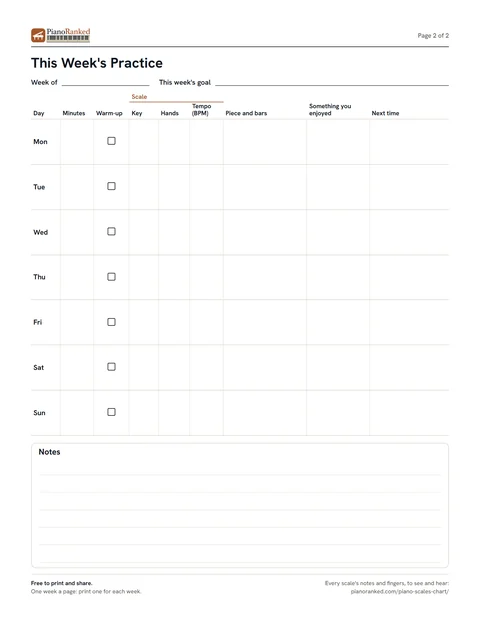
The piano practice log
One week a page: print a new one each week and keep it on the music rest.
What to play it on
Any piano or keyboard works for this routine. For a first piano with weighted keys and all 88 notes, the Yamaha
View on Amazon for the Yamaha P-225 (opens in a new tab)
For quiet practice, Kovarsky suggests headphones, and Roland points out they let you practice late at night or early in the morning. Our guide to piano headphones compares them.
FAQ
What should a pianist practice every day?
A short warm-up, one scale, the piece you're learning and something you enjoy. Jerry Kovarsky, writing for Yamaha, keeps scales to no more than about 20% of the time and gives a new piece about 30%. Our routine above splits 15, 30 or 45 minutes along those lines and times each part.
What's the best way to practice a new piece?
In small sections, slowly. Yamaha's tips suggest working on one bar to a page at a time and not always starting at the beginning, and Roland suggests tapping the rhythm before you play. In a 2009 study of 17 advanced piano students, how often they played a passage correctly mattered more than how long they practiced.
What are Hanon exercises?
Sixty finger exercises from Charles-Louis Hanon's The Virtuoso Pianist, first published in 1873, for agility, independence, strength and evenness of the fingers. Its publisher says almost anyone with more than two years of piano lessons has played from it, so beginners start with a simple five-finger exercise instead. The original is free on IMSLP.
Can you practice piano without a piano?
Yes, a little. Yamaha's tips suggest practicing a hard passage's fingering away from the piano and listening to the piece often. Roland's five-finger exercise can be tapped on a desk, and a Yamaha educator has students march or tap their thighs while singing the melody, to keep a steady beat.
Is it "practice" or "practise"?
In American English, "practice" is both the noun and the verb: you practice the piano every day. British English spells the verb "practise" and keeps "practice" for the noun, as the Cambridge and Oxford dictionaries show, and Cambridge marks "practise" as Canadian too.
You've reached the end
You can now plan a practice session, time it and keep track of it.
Sources
- Yamaha: Eight great tips for practicing piano
- Yamaha, Jerry Kovarsky: Effective time management for keyboard practice
- Roland: Teach yourself piano (lessons with Pianist magazine's Tim Stein)
- Roland: How long does it take to learn piano?
- Yamaha educators: Fix it, rhythmic accuracy
- Duke, Simmons and Cash (2009), Journal of Research in Music Education: practice behavior and next-day performance
- Baylor University, Piano Basics: One-octave major scales
- Baylor University, Piano Basics: Harmonic minor scales, D, A and E
- IMSLP: The Virtuoso Pianist (Hanon, Charles-Louis)
- Hal Leonard: Hanon, The Virtuoso Pianist in 60 Exercises, Complete (Schirmer's Library Vol. 925)
- Cambridge Dictionary: the British spelling of the verb
- Cambridge Dictionary: practice, in American English
- Oxford Learner's Dictionaries: the British spelling of the verb