


How to use it
- Tap a key, then a scale: major, or one of the three minors. One octave of it shows on the keys, with its notes and its steps underneath.
- Choose Right hand or Left hand to see that hand's finger numbers on the keys. The major and harmonic minor scales have them.
- Tap Play it to hear the scale up and down at 60 beats a minute, one note a beat, or tap any key to hear that note.
To keep the scales by your piano, print the 12 minor scales from this page, or the 12 major scales from our fingering chart.
What a scale is: whole and half steps
A scale runs from one note up to the same note an octave higher. On the piano a half step is the very next key, black or white, and a whole step skips one key: C to C♯ is a half step, and C to D is a whole step.
Each kind of scale has its own pattern of whole and half steps, so the same pattern started on any key gives that key's scale. Our piano notes chart names every key, sharps and flats included. The sharps or flats a scale uses are its key signature, written once at the start of a piece.
The major scale pattern
Every major scale follows the same steps: whole, whole, half, whole, whole, whole, half. From C that gives C D E F G A B C, all on white keys.
From any other key the pattern needs black keys: D major is D E F♯ G A B C♯ D, and E♭ major is E♭ F G A♭ B♭ C D E♭.
The three minor scales
Each key also has a minor scale, written in three forms. The natural minor follows whole, half, whole, whole, half, whole, whole: A natural minor is A B C D E F G A, all on white keys.
The harmonic minor raises the seventh note by a half step, so C minor's B♭ becomes B, which leaves a step and a half between its sixth and seventh notes. The melodic minor raises the sixth and seventh notes on the way up: C melodic minor goes up C D E♭ F G A B C. Coming down, it's usually played as the natural minor, and Play it does the same.
A minor scale shares its sharps or flats with the major scale three half steps above it: A minor and C major have none, and D minor and F major have one flat, B♭.
Baylor University's Piano Basics, where the minor fingers on this page come from, teaches only the harmonic minor. So the tool shows finger numbers on the harmonic minors, and the notes alone for the natural and melodic forms.
Which scales to learn first
Baylor University's Piano Basics starts with C, G, D, A and E major, which all use the same fingers in each hand; it remembers them as the word CAGED. It adds F and B next, then D♭ and G♭, then B♭, E♭ and A♭.
Its minors start with D, A and E, then C and G, then F and B, then the five that start on black keys. Baylor notes that a minor scale starting on a white key keeps its major scale's fingers, so once you know a major, only its third and sixth notes change for the harmonic minor.
How to practice scales
Go slowly, with a steady beat. Play it sounds one note a second, 60 beats a minute, and a metronome set to 60 keeps you at the same pace; our guide to metronomes for piano practice compares them.
Learn each hand on its own first, then put them together. Baylor's rules for scale fingering: the thumb never plays a black key, the fingers work in groups of three and four, and finger 5 plays only the top note in the right hand and the bottom note in the left.
Our piano fingering chart explains the finger numbers and how the thumb passes under, with C major step by step.
The free printables
Two charts to print and keep by your piano, each in US Letter and A4: the 12 minor scales from this page, and the 12 major scales from our fingering chart.
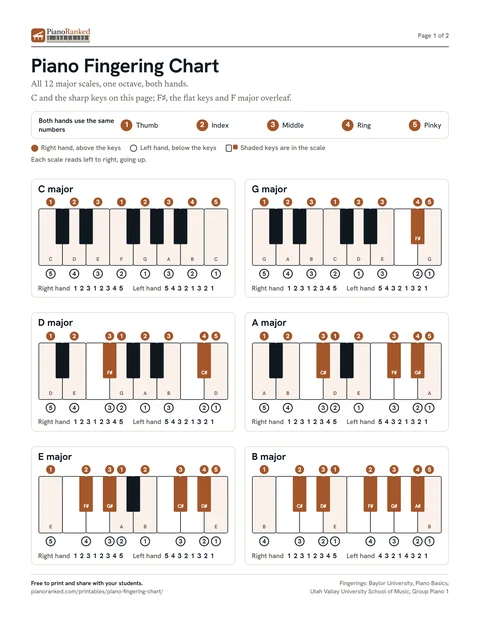
The 12 major scales
From our fingering chart: both hands' fingers for every major scale, one octave each.
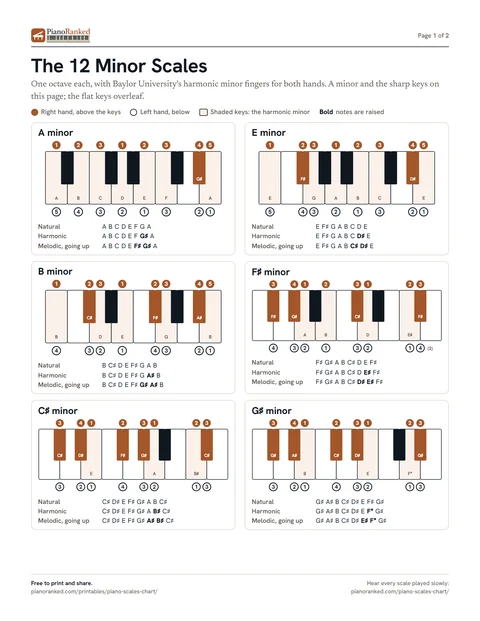
The 12 minor scales
Natural, harmonic and melodic, with Baylor University's harmonic minor fingers for both hands.
A book of scales
For written-out exercises in every key, Alfred's Basic Book of Scales, Chords, Arpeggios & Cadences covers all the major scales and the natural, harmonic and melodic minors, its publisher says, with each key's chords, arpeggios and cadences beside its scales. For method books, see our guide to piano books for beginners.
View on Amazon for the Alfred's Basic Book of Scales (opens in a new tab)
What to play it on
Any piano or keyboard plays these scales. For a first piano with weighted keys and all 88 notes, the Yamaha
View on Amazon for the Yamaha P-225 (opens in a new tab)
Next, our easy piano songs put the notes to work.
FAQ
What are the 12 major scales on piano?
C, G, D, A, E, B, F♯, D♭, A♭, E♭, B♭ and F major, one starting on each of the 12 keys. F♯ major can also be written as G♭ major, and D♭ major as C♯ major. All 12 follow the same steps: whole, whole, half, whole, whole, whole, half. Pick any of them above to see and hear it.
What are the basic piano scales?
The major and minor scales, one of each on every key. C major and A natural minor use only white keys. Baylor University's Piano Basics starts with C, G, D, A and E major, five scales that share the same fingers in each hand.
What's the difference between major and minor scales?
The pattern of steps. A major scale goes whole, whole, half, whole, whole, whole, half; a natural minor goes whole, half, whole, whole, half, whole, whole. So the minor's third, sixth and seventh notes are a half step lower: C minor has E♭, A♭ and B♭ where C major has E, A and B.
Do I need to learn every scale?
Not to start. Baylor University's Piano Basics teaches them in stages: five majors that share one fingering, then the rest of the majors, then the minors. Learn the ones your pieces use first, and come back to the tool above for any other.
Do the left and right hands use the same fingers?
Not quite. In C major the right hand plays 1 2 3 1 2 3 4 5 going up, and the left hand 5 4 3 2 1 3 2 1. Baylor University's Piano Basics describes the left hand's fingering as the inverse of the right's. Switch hands in the tool above to see each one.
You've reached the end
You can now find, play and print any major or minor scale.
Sources
- musictheory.net: The Major Scale
- musictheory.net: The Minor Scales
- Baylor University, Piano Basics: One-octave major scales
- Baylor University, Piano Basics: Minor scales
- Baylor University, Piano Basics: Harmonic minor scales, D, A and E
- Baylor University, Piano Basics: Harmonic minor scale fingerings
- Baylor University, Piano Basics: Major scale fingerings
- Utah Valley University School of Music: Group Piano 1 packet (scale fingering charts)
- Alfred Music: The Basic Book of Scales, Chords, Arpeggios & Cadences