


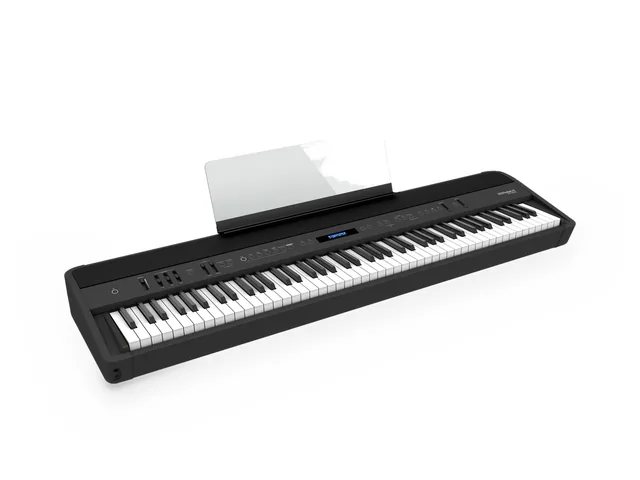
The short answer
Compare all 6 pianos-
No. 1 · Our top pick
Best Overall for Advanced
- Key action
- PHA-50 (wood-plastic hybrid)
- Polyphony
- 256 (piano tones: limitless)
- Weight
- 52 lbs 1 oz (23.6 kg) with music rest
PHA-50 wood-and-plastic keys with escapement, Pure Acoustic Piano Modeling, four speakers (25 W × 2 + 5 W × 2), a mic input and MIDI ports: one instrument for home, studio and small gigs.
-
No. 2
Best Console for Classical Practice
- Key action
- Grand Feel Compact (wooden keys)
- Polyphony
- 256
- Weight
- 145.5 lbs (66 kg)
Grand Feel Compact action with wooden keys on all 88 notes, let-off and triple sensing, Harmonic Imaging XL sound and three pedals with half-pedal: the closest to an acoustic piano here.
-
No. 3
Best Portable for Gigging
- Key action
- NW-GH3 (Natural Wood, triple sensor)
- Polyphony
- 128
- Weight
- 41 lbs (18.6 kg)
NW-GH3 Natural Wood keys with a third sensor, dedicated controls for its piano, electric piano and sub sections, and balanced XLR outputs: built for the stage.
-
No. 4
Best Wooden-Key Portable
- Key action
- GrandTouch-S (wooden white keys)
- Polyphony
- 256
- Weight
- 48 lbs 8 oz (22.0 kg)
The P-525 is the portable route to wooden keys, and the natural step for Yamaha players coming from a P-145 or P-225.
-
No. 5
Best Traditional Cabinet
- Key action
- GrandTouch-E (escapement)
- Polyphony
- 192
- Weight
- 92 lbs 10 oz (42 kg)
The YDP-166 suits advanced players who want a Yamaha console for daily practice, with escapement keys, three pedals and two headphone jacks, and who don't need wooden keys or line outputs.
-
No. 6
Best Entry-Advanced Portable
- Key action
- PHA-4 Standard
- Polyphony
- 256
- Weight
- 42 lbs 9 oz (19.3 kg) with music rest
The FP-60X is the lighter, lower-cost route into Roland's home-and-stage idea: the same mic input and wireless connections as the FP-90X, with the PHA-4 Standard keyboard and SuperNATURAL Piano.
Quick Comparison: All 6 Advanced Picks
Swipe the table sideways to see every column.
| Rank | Best for | Key action | Polyphony | Form | Weight | Amazon |
|---|---|---|---|---|---|---|
| Roland FP-90X | Best Overall for Advanced | PHA-50 (wood-plastic hybrid) | 256 (piano tones: limitless) | Portable | 52 lbs 1 oz (23.6 kg) with music rest | Check price on Amazon for the Roland FP-90X (opens in a new tab) |
| Kawai CA501 | Best Console for Classical Practice | Grand Feel Compact (wooden keys) | 256 | Console | 145.5 lbs (66 kg) | Check price on Amazon for the Kawai CA501 (opens in a new tab) |
| Yamaha CP88 | Best Portable for Gigging | NW-GH3 (Natural Wood, triple sensor) | 128 | Stage | 41 lbs (18.6 kg) | Check price on Amazon for the Yamaha CP88 (opens in a new tab) |
| Yamaha P-525 | Best Wooden-Key Portable | GrandTouch-S (wooden white keys) | 256 | Portable | 48 lbs 8 oz (22.0 kg) | Check price on Amazon for the Yamaha P-525 (opens in a new tab) |
| Yamaha YDP-166 | Best Traditional Cabinet | GrandTouch-E (escapement) | 192 | Console | 92 lbs 10 oz (42 kg) | Check price on Amazon for the Yamaha YDP-166 (opens in a new tab) |
| Roland FP-60X | Best Entry-Advanced Portable | PHA-4 Standard | 256 | Portable | 42 lbs 9 oz (19.3 kg) with music rest | Check price on Amazon for the Roland FP-60X (opens in a new tab) |
Tip
At this level, judge the action and the piano engine together, because each maker designs them as a pair: Roland's PHA-50 with Pure Acoustic Piano Modeling on the FP-90X, Kawai's Grand Feel Compact with Harmonic Imaging XL on the CA501, Yamaha's GrandTouch-S with CFX and Bösendorfer Imperial samples on the P-525. Then check the pedals: a single damper pedal and a built-in three-pedal unit make very different instruments for classical repertoire.
Which one fits you?
Where will you play it most?
Start with the Kawai CA501 or the Roland FP-90X.
Start with the Yamaha CP88 or the Roland FP-60X.
Start with the Roland FP-90X.
No. 2
Kawai CA501
Best Console for Classical Practice
No. 1
Roland FP-90X
Best Overall for Advanced
No. 3
Yamaha CP88
Best Portable for Gigging
No. 6
Roland FP-60X
Best Entry-Advanced Portable
No. 1
Roland FP-90X
Best Overall for Advanced
You're past the beginner and intermediate stages: you know what escapement is, why a third key sensor helps repeated notes, and how much half-pedaling matters in Debussy. The best digital piano for advanced players isn't a single answer; it's the right mix of action, piano sound, pedals and form for how you play. This guide ranks six instruments with current Amazon US offers, from the makers' own specs: two Roland portables, Kawai's wooden-key CA501 console, Yamaha's CP88 for the stage, the wooden-key P-525 portable and a traditional Yamaha console. If you're still building technique, our Intermediate guide may suit you better. We haven't played these pianos.
Read the rest of the introduction
It's also written for classical pianists: the wooden-key picks, the three-pedal consoles and the section on classical repertoire below cover what matters for graded exams, conservatory study and recital practice. For a ranked list across every budget and level, start with our best digital pianos guide.
The short answer: the Roland FP-90X is the best digital piano for advanced players overall, because it works at home, in the studio and on a gig: PHA-50 keys with escapement, Pure Acoustic Piano Modeling, four speakers, a mic input and MIDI ports. The Kawai CA501 is the pick for classical and home practice, with wooden keys on all 88 notes, let-off and three pedals in a cabinet. The Yamaha CP88 is the choice for gigging pianists: Natural Wood keys, dedicated live controls and balanced XLR outputs.

Best Overall for Advanced
Roland FP-90X — The Stage-and-Studio Flagship


- Angle
- On its stand
- From above
- PHA-50 hybrid keybed under the hands
Features
- Key action
- PHA-50, wood and plastic hybrid
- Sound engine
- Pure Acoustic Piano Modeling
- Polyphony
- 256 (piano tones limitless)
- Speakers
- 25 W × 2 + 5 W × 2
- Connectivity
- Bluetooth, mic input, MIDI
- Weight
- 52 lbs 1 oz (23.6 kg)
Buy it if this is you
advanced pianists who practice at home and also gig or record, and singer-pianists who want the mic input.
Skip it if this is you
classical players who want wooden keys throughout and three pedals in a cabinet (the CA501), or pianists who need balanced XLR outputs at every gig (the CP88).
Read the full review: Roland FP-90X
Our verdict
The FP-90X is the best digital piano for advanced players who want one instrument for home and stage. Roland's PHA-50 keyboard and Pure Acoustic Piano Modeling are its flagship pair; the four-speaker system covers practice and small rooms, and the mic input, MIDI ports and USB audio make it a recording hub. Add the KPD-90 and KSC-90 stand for three pedals at home. For the wider line-up, compare our Roland digital pianos guide.
Pros
- +PHA-50 keys: wood sides, escapement and Ebony/Ivory Feel keytops
- +Pure Acoustic Piano Modeling, with limitless polyphony on its piano tones when you play solo
- +Four speakers rated 25 W × 2 plus 5 W × 2
- +1/4-inch mic input with effects, for singing pianists
- +MIDI In and Out, USB audio and Bluetooth audio and MIDI
Cons
- –52 lbs to carry to gigs
- –Only a single damper pedal in the box; the KPD-90 three-pedal unit needs Roland's KSC-90 stand
- –No balanced XLR outputs (the CP88 has them)
- –A wood and plastic hybrid, not wooden keys throughout
How it plays and sounds
The FP-90X is Roland's flagship portable, and the one pick here built for home practice, recording and playing out. Roland lists the PHA-50 keyboard, a wood and plastic hybrid with escapement and Ebony/Ivory Feel keytops, and Pure Acoustic Piano Modeling, which Roland says reproduces how an acoustic grand's sound is created. Four speakers are rated 25 W × 2 plus 5 W × 2, and the connections suit stage and studio: 1/4-inch outputs, a 1/4-inch mic input with effects, MIDI In and Out, USB audio and MIDI, and Bluetooth audio and MIDI. See Roland's FP-90X product page and our full Roland FP-90X review.
View full specs
| Key action | PHA-50: wood and plastic hybrid, escapement, Ebony/Ivory Feel keytops |
|---|---|
| Sound engine | Pure Acoustic Piano Modeling |
| Polyphony | Piano tones: limitless (solo playing); other tones: 256 |
| Voices | 362 tones (Roland spec sheet) |
| Speakers | 25 W × 2 + 5 W × 2 (two woofers, two tweeters) |
| Pedal | DP-10 damper pedal included (continuous detection); KPD-90 three-pedal unit optional |
| Connectivity | Bluetooth audio and MIDI, USB audio and MIDI, MIDI In/Out, 1/4" outputs, 1/4" mic input, two headphone jacks |
| Weight | 52 lbs 1 oz (23.6 kg) with music rest |
Take a closer look.
PHA-50 keys with escapement, and the front panel.
On its matching stand.
All 88 keys, seen from above.
PHA-50 hybrid keybed under the hands

Premium upright cabinet, shown in black.

The same cabinet in rosewood.
Grand Feel Compact wooden-key action

Transparent dedicated controls for each section.

Rear connectivity with balanced XLR outputs
Best Console for Classical Practice
Kawai CA501 — Wooden Keys on All 88 Notes
- Angle
- In rosewood
- Grand Feel Compact wooden-key action
Features
- Key action
- Grand Feel Compact, 88 wooden keys
- Sound engine
- Harmonic Imaging XL
- Polyphony
- 256 notes
- Speakers
- 100 W (50 W + 50 W)
- Connectivity
- Bluetooth, USB, line out
- Weight
- 145.5 lbs (66 kg)
Buy it if this is you
classical pianists, conservatory and exam students, and home players who want wooden keys and three pedals in one cabinet.
Skip it if this is you
gigging (the FP-90X or CP88), or rooms where a cabinet 48.5 cm (19 inches) deep won't fit.
Read the full review: Kawai CA501
Our verdict
The CA501 is the pick for classical pianists and anyone whose piano stays at home. It's the only pick here with wooden keys on all 88 notes, and Kawai pairs that action with three pedals and concert grand samples in a furniture cabinet. Choose it for daily repertoire practice, exam and conservatory preparation and long-term ownership; choose a portable if the piano has to travel. For a narrower repertoire-first view, see our digital piano for classical guide, or compare the Kawai digital pianos line-up.
Pros
- +Wooden keys on all 88 black and white keys
- +Let-off simulation, triple sensing and counterweights in the bass
- +Harmonic Imaging XL, built on Kawai grand piano samples
- +Three pedals, with half-pedal on the damper and soft
- +100 W four-speaker system
Cons
- –145.5 lbs: plan the delivery and placement
- –No mic input and no MIDI DIN ports (USB and Bluetooth MIDI only)
- –Line outputs are unbalanced
- –A console: it stays where you put it
How it plays and sounds
The CA501 is the entry to Kawai's Concert Artist consoles, and the most acoustic-like action in this guide. Kawai's Grand Feel Compact action uses long wooden keysticks for all 88 black and white keys, with grade-weighted hammers, let-off simulation, triple-sensor key detection and counterweights in the bass, in a smaller unit than Kawai's full Grand Feel actions. The sound is Harmonic Imaging XL, built on samples of Kawai's SK-EX, SK-5 and EX grand pianos, with damper, string and cabinet resonance. The three Grand Feel pedals give half-pedal on the damper and soft, and a 100 W (50 W + 50 W) four-speaker system fills the room. See Kawai's CA501 product page.
View full specs
| Key action | Grand Feel Compact: 88 wooden keys, grade-weighted hammers, let-off, triple sensor, bass counterweights, Ivory Touch white keys |
|---|---|
| Sound engine | Harmonic Imaging XL (SK-EX-L, SK-5, EX, K-60 samples) with damper, string and cabinet resonance |
| Polyphony | 256 notes |
| Voices | 45 |
| Speakers | 100 W (50 W + 50 W), four speakers |
| Pedals | Three: damper and soft with half-pedal, sostenuto |
| Connectivity | Bluetooth MIDI and audio, USB to Host (MIDI), USB to Device, 1/4" line out and line in, two headphone jacks |
| Weight | 145.5 lbs (66 kg) |
Best Portable for Gigging
Yamaha CP88 — Natural Wood Keys and XLR Outputs for the Gig
- Angle
- Rear connectivity with balanced XLR outputs
Features
- Key action
- NW-GH3 Natural Wood, triple sensor
- Sound engines
- CFX, Bösendorfer Imperial, U1 and more
- Polyphony
- 128 notes
- Front panel
- Dedicated controls per section
- Connectivity
- XLR outputs, USB audio + MIDI
- Weight
- 41 lbs (18.6 kg)
Buy it if this is you
gigging pianists, worship and band keyboardists, and players who need balanced outputs.
Skip it if this is you
home practice without speakers or headphones, or classical players who want three pedals (the CA501 or YDP-166).
Read the full review: Yamaha CP88
Our verdict
The CP88 is the right pick for gigging pianists, worship and band keyboardists, and anyone whose piano lives on stage. The dedicated section controls make sound changes quick between songs, and the XLR outputs suit any PA. At home it needs headphones or speakers, so for most classical players it's a second instrument. If you need speakers built in, the FP-90X is the stage-and-home alternative.
Pros
- +Natural Wood keys with a third sensor for fast repetition
- +Dedicated controls for each section, without menu diving
- +Balanced XLR outputs straight to a PA
- +Pianos, electric pianos and organs in one instrument
- +41 lbs, light for an 88-key wooden action
Cons
- –No speakers: it needs an amp, a PA or headphones
- –128-note polyphony, the lowest here
- –No Bluetooth
- –One headphone jack, and no music rest in the box
How it plays and sounds
The CP88 is Yamaha's stage instrument for working pianists, and the only pick here built purely for playing live. Yamaha lists the NW-GH3 (Natural Wood Graded Hammer) keyboard, with a third sensor for grand piano-like repetition and synthetic ebony and ivory keytops. Its Piano, Electric Piano and Sub sections each have dedicated controls, with pianos including the CFX, Bösendorfer Imperial and U1, Yamaha's CP80 and tine and reed electric pianos, and tonewheel, transistor and pipe organs. Balanced XLR outputs go straight to a PA; there are no speakers, so plan an amp, a PA or headphones. See Yamaha's CP88 page and our guide to the best stage pianos.
View full specs
| Key action | NW-GH3 (Natural Wood Graded Hammer), triple sensor, synthetic ebony and ivory keytops |
|---|---|
| Sound engines | AWM2: CFX, Bösendorfer Imperial, U1 and more; CP80, tine and reed electric pianos; tonewheel, transistor and pipe organs |
| Polyphony | 128 notes |
| Voices | 129 (Yamaha spec sheet: 18 piano, 19 electric piano, 92 sub) |
| Front panel | Dedicated controls for the Piano, Electric Piano and Sub sections |
| Effects | Insertion effects per section, delay, hall reverb, 3-band master EQ |
| Connectivity | Balanced XLR and unbalanced 1/4" outputs, USB to Host and to Device, MIDI In/Out, one headphone jack |
| Pedal | FC3A foot pedal included |
| Weight | 41 lbs (18.6 kg) |
Best Wooden-Key Portable
Yamaha P-525 — Wooden White Keys in a Portable


- Angle
- Control panel over the GrandTouch-S keybed
Features
- Key action
- GrandTouch-S, wooden white keys
- Sound engine
- CFX + Bösendorfer Imperial
- Polyphony
- 256 notes
- Speakers
- (20 W + 6 W) × 2
- Connectivity
- Bluetooth, USB audio, MIDI
- Weight
- 48 lbs 8 oz (22.0 kg)
Buy it if this is you
Yamaha players upgrading from a P-series portable, and classical students who want wooden keys in a portable.
Skip it if this is you
singer-pianists who need a mic input (the FP-90X), or stage use with balanced outputs (the CP88).
Read the full review: Yamaha P-525
Our verdict
The P-525 is the portable route to wooden keys, and the natural step for Yamaha players coming from a P-145 or P-225. Its GrandTouch-S action comes from Yamaha's top Clavinova pianos, and the USB audio interface suits home recording. Budget for the LP-1 and the L-515 stand if you want three pedals for classical repertoire. Compared with the FP-90X, it trades the mic input and the larger speaker system for wooden white keys. For more Yamaha options, compare our Yamaha digital pianos guide.
Pros
- +Wooden white keys with escapement
- +CFX and Bösendorfer Imperial samples with VRM
- +USB audio interface, Bluetooth audio and MIDI, and MIDI ports
- +Lighter than the FP-90X
Cons
- –Three pedals need the LP-1 and the L-515 stand
- –The black keys aren't wood
- –No mic input
- –A smaller speaker system than the FP-90X
How it plays and sounds
The P-525 is Yamaha's flagship portable, with the GrandTouch-S keyboard that Yamaha says features in its top-of-the-line Clavinova pianos: wooden white keys, synthetic ebony and ivory keytops and escapement. It plays Yamaha's CFX and Bösendorfer Imperial concert grand samples with VRM resonance and Grand Expression Modeling, with 256-note polyphony. The speakers are rated (20 W + 6 W) × 2, and it has Bluetooth audio and MIDI, a USB audio interface, MIDI In and Out and two headphone jacks. See Yamaha's P-525 page and our Yamaha P-525 review.
View full specs
| Key action | GrandTouch-S: wooden white keys, synthetic ebony and ivory keytops, escapement |
|---|---|
| Sound engine | Yamaha CFX and Bösendorfer Imperial samples, VRM, Grand Expression Modeling |
| Polyphony | 256 notes |
| Voices | 44 voices + 18 drum/SFX kits + 480 XG voices |
| Speakers | (20 W + 6 W) × 2 |
| Pedal | FC3A foot pedal included; LP-1 three-pedal unit optional (with the L-515 stand) |
| Connectivity | Bluetooth audio and MIDI (varies by area), USB audio interface, MIDI In/Out, AUX in and out, two headphone jacks |
| Weight | 48 lbs 8 oz (22.0 kg) |
Best Traditional Cabinet
Yamaha YDP-166 — The Traditional Practice Console


- Angle
- At home, in a dark finish
Features
- Key action
- GrandTouch-E, escapement
- Sound engine
- CFX with VRM Lite
- Polyphony
- 192 notes
- Speakers
- 20 W × 2
- Connectivity
- Bluetooth, USB audio, two headphone jacks
- Weight
- 92 lbs 10 oz (42 kg)
Buy it if this is you
home practice on a traditional console, including lessons with two pairs of headphones.
Skip it if this is you
players who want wooden keys (the CA501 or P-525) or line outputs for recording.
Read the full review: Yamaha YDP-166
Our verdict
The YDP-166 suits advanced players who want a Yamaha console for daily practice, with escapement keys, three pedals and two headphone jacks, and who don't need wooden keys or line outputs. Next to the CA501, it gives up the wooden keys and Kawai's larger sound system; next to the P-525, it trades wooden white keys and portability for built-in pedals and a cabinet.
Pros
- +GrandTouch-E keys with escapement
- +Three pedals with half-pedal, built into the cabinet
- +Bluetooth audio and MIDI, and a USB audio interface
- +Two headphone jacks for silent practice and lessons
Cons
- –GrandTouch-E keys aren't wooden
- –10 voices and 192-note polyphony
- –No line out
- –42 kg: it stays where you put it
How it plays and sounds
The YDP-166 is a Yamaha ARIUS console for players who want a traditional cabinet with three pedals for daily practice. Yamaha lists the GrandTouch-E keyboard with synthetic ebony and ivory keytops and escapement, its CFX concert grand sample with VRM Lite and 192-note polyphony, plus three pedals with half-pedal on the damper, 20 W × 2 speakers and two headphone jacks. It adds Bluetooth audio and MIDI (varies by area) and a USB audio interface, but has no line out. Yamaha launched the YDP-166 in June 2026, and Yamaha USA's Arius line-up now lists it and no longer the YDP-165; Yamaha doesn't call it a successor. It comes in Black, Dark Rosewood, White Birch and White; the listing we link is White Birch. See Yamaha's YDP-166 specs.
View full specs
| Key action | GrandTouch-E, synthetic ebony and ivory keytops, escapement |
|---|---|
| Sound engine | Yamaha CFX sample with VRM Lite |
| Polyphony | 192 notes |
| Voices | 10 |
| Speakers | 20 W × 2 |
| Pedals | Three: damper with half-pedal, sostenuto, soft |
| Connectivity | Bluetooth audio and MIDI (varies by area), USB to Host with USB audio, two headphone jacks; no line out |
| Weight | 92 lbs 10 oz (42 kg) |
Best Entry-Advanced Portable
Roland FP-60X — The Entry into Advanced-Tier Roland


- Angle
- Panel with music-rest tablet
Features
- Key action
- PHA-4 Standard, escapement
- Sound engine
- SuperNATURAL Piano
- Polyphony
- 256 notes
- Speakers
- 13 W × 2
- Connectivity
- Bluetooth, mic input, USB audio
- Weight
- 42 lbs 9 oz (19.3 kg)
Buy it if this is you
advanced-intermediate players stepping up, singer-pianists, and players who move the piano often.
Skip it if this is you
players who want wooden keys (the P-525 or CA501), or MIDI DIN ports for older gear (the FP-90X).
Read the full review: Roland FP-60X
Our verdict
The FP-60X is the lighter, lower-cost route into Roland's home-and-stage idea: the same mic input and wireless connections as the FP-90X, with the PHA-4 Standard keyboard and SuperNATURAL Piano. It suits players stepping up from an entry portable who sing as they play or carry the piano often. If the keys matter most, the FP-90X's PHA-50 is the step up.
Pros
- +A mic input with effects, like the FP-90X
- +Escapement on the PHA-4 Standard keyboard
- +Bluetooth audio and MIDI, and USB audio
- +About 9 lbs lighter than the FP-90X
Cons
- –PHA-4 Standard, not the FP-90X's wood-sided PHA-50
- –SuperNATURAL Piano rather than Pure Acoustic Piano Modeling
- –13 W × 2 speakers
- –No MIDI DIN ports
How it plays and sounds
The FP-60X sits below the FP-90X in Roland's portable range. Roland lists the PHA-4 Standard keyboard with escapement and Ivory Feel keytops, the SuperNATURAL Piano engine, 256-note polyphony and a 26-watt stereo speaker system (13 W × 2). It keeps the FP-90X's 1/4-inch mic input with effects, Bluetooth audio and MIDI, and USB audio, but has no MIDI DIN ports; a DP-10 damper pedal comes in the box. See Roland's FP-60X product page.
View full specs
| Key action | PHA-4 Standard: escapement, Ivory Feel keytops |
|---|---|
| Sound engine | SuperNATURAL Piano |
| Polyphony | 256 notes |
| Voices | 358 tones (Roland spec sheet) |
| Speakers | 13 W × 2 |
| Pedal | DP-10 damper pedal included (continuous detection); KPD-90 three-pedal unit optional (with the KSC-72 stand) |
| Connectivity | Bluetooth audio and MIDI, USB audio and MIDI, 1/4" outputs, 1/4" mic input, two headphone jacks; no MIDI DIN |
| Weight | 42 lbs 9 oz (19.3 kg) with music rest |
What Advanced Players Actually Need
At the advanced level, the action, the piano engine and the pedals work as one system, and several specs that hardly mattered earlier start to decide the choice.
Read more: action expressiveness, sound engine depth, polyphony, pedals, recording and MIDI
Action expressiveness: escapement, sensors, wooden keys
Look for three things in the maker's own words. Escapement (Kawai calls it let-off) imitates the notch you feel near the bottom of a grand piano's key: Roland lists it on the PHA-50 and PHA-4 Standard, Yamaha on GrandTouch-S and GrandTouch-E, Kawai on Grand Feel Compact. A third key sensor helps fast repeated notes; Kawai lists it on the CA501, and Yamaha on the CP88's NW-GH3. Wood varies: wooden keys on all 88 notes on the CA501, wooden white keys on the P-525, Natural Wood keys on the CP88 and a wood and plastic hybrid on the FP-90X. For the basics, see our weighted vs semi-weighted keys guide.
Sound engine depth: modeling, sampling and resonance
The engines here take two routes. Roland's Pure Acoustic Piano Modeling (FP-90X) and SuperNATURAL Piano (FP-60X) recreate how an acoustic piano makes its sound, in Roland's words. Yamaha and Kawai start from concert grand samples and add resonance: Yamaha's VRM on the P-525 (VRM Lite on the YDP-166), Kawai's damper, string and cabinet resonance on the CA501. Both routes can sound convincing; listen through headphones and through the speakers before you choose.
Polyphony: how many notes you need
Polyphony is how many notes the piano can sound at once, and pedaled passages and layered sounds use it up fastest. Four picks list 256 notes, and the FP-90X's piano tones are limitless when you play solo; the YDP-166 lists 192 and the CP88 128, which is plenty for most stage work but the lowest here for dense, pedaled repertoire.
Pedals: half-pedal, sostenuto and what comes in the box
Half-pedal control matters most in Debussy, Ravel and Romantic repertoire. The consoles have it built in: the CA501's three pedals give half-pedal on the damper and soft, the YDP-166's on the damper, with a sostenuto on both. The Roland portables come with a DP-10 damper pedal that detects continuously, and the KPD-90 three-pedal unit is optional; the P-525 needs the LP-1 and its stand for three pedals.
Recording and MIDI: what each one connects to
Check each connection on the spec sheet, because none is standard here. Bluetooth audio and MIDI are on the FP-90X, FP-60X, CA501, P-525 and YDP-166 (varies by area on the Yamahas), but not the CP88. Only the CP88 has balanced XLR outputs, and the YDP-166 has no line out. The FP-90X and FP-60X have mic inputs; the FP-90X, CP88 and P-525 have MIDI DIN ports; and the FP-90X, FP-60X, CP88, P-525 and YDP-166 work as USB audio interfaces.
For Classical Pianists: What to Look For
Classical repertoire asks the most of a digital piano's action and pedals, so classical pianists can narrow this list quickly.
Read more: keys that prepare you for an acoustic grand, three pedals with half-pedal, tuning, temperaments and practice tools, exams and recitals
Keys that prepare you for an acoustic grand
Wooden keys, escapement and graded weighting bring practice closer to the instrument you'll perform on. The CA501 has wooden keys on all 88 notes with let-off, the P-525 wooden white keys with escapement, and the FP-90X Roland's wood-sided PHA-50 with escapement.
Three pedals with half-pedal
Sostenuto and half-pedaling are part of the repertoire from Debussy on. The CA501 and YDP-166 have three pedals built in; on the portables, add Roland's KPD-90 or Yamaha's LP-1 with the matching stand.
Tuning, temperaments and practice tools
Kawai's Virtual Technician on the CA501 includes temperaments, stretch tuning and half-pedal adjustment, and Kawai builds in lesson pieces by Burgmüller, Czerny and Bach; the FP-90X lists 10 temperaments. Two headphone jacks on most picks make lessons possible in silence.
Exams and recitals
A digital piano is a sound tool for daily practice, but time on an acoustic grand before an exam or recital still matters: the touch of that instrument and the sound of the room can't be rehearsed at home. If you're choosing mainly for classical study, also see our guide to the best digital pianos for classical music.
Other Advanced Pianos, and Why They're Not Ranked
Two well-known instruments are out of the ranking because Amazon US had no featured offer when we checked, and two more are worth knowing about.
Read more: Kawai CA901, Nord Stage 4 88, Kawai ES920, Yamaha YDP-165
Kawai CA901
Kawai's flagship Concert Artist console, with the Grand Feel III action (wooden keys, let-off, triple sensor and counterweights on all 88 keys), SK-EX Rendering and TwinDrive soundboard speakers, per Kawai. Amazon US showed it as unavailable, so it has no button here.
Nord Stage 4 88
Nord's piano, organ and synth stage keyboard, with an 88-key triple-sensor hammer action. Our Nord Piano 5 vs Piano 6 guide ranks it among the Nords you can buy, and our full Nord Stage 4 review compares the three sizes; it's here on Amazon.
Kawai ES920
The top of Kawai's ES portable range, and an alternative to the FP-90X and P-525 with Kawai's Responsive Hammer III action. Our Kawai ES920 review compares them; it's here on Amazon.
Yamaha YDP-165
Yamaha launched the YDP-166 in June 2026, and Yamaha USA's Arius line-up now lists it and no longer the YDP-165; Yamaha doesn't call it a successor. The YDP-165 has the GH3 keyboard and connects by USB, with no Bluetooth, per Yamaha's YDP-165 page. When we checked, Amazon US had no featured offer for it, so it has no button here; our digital upright piano guide ranks the Arius models you can buy.
Digital vs Acoustic at the Advanced Level
The digital-vs-acoustic question changes at the advanced level. For beginners and intermediate players, practical reasons usually settle it for digital; for advanced players the trade-offs are real, and the answer depends on what you're preparing for.
Read more: where acoustic still wins, where digital wins, when a digital genuinely replaces an acoustic
Where acoustic still wins
Three places. Harmonic complexity at fortissimo: a low note struck hard on a grand sets the whole soundboard ringing, and speaker systems can only approximate it. The feel of a particular instrument: every acoustic action is regulated differently, and performers adapt to the piano they'll play. Pedal and string interaction: the way dampers, strings and key release interact on a real grand has subtleties that half-pedal sensing only approximates.
Where digital wins
Silent practice: headphones make late sessions and shared homes workable. Versatility: the CP88 covers pianos, electric pianos and organs on stage, and the FP-90X covers practice, recording and small rooms in one instrument. Upkeep: no tuning, no regulation and no sensitivity to humidity. Recording: USB audio, Bluetooth and line outputs make recording far simpler than placing microphones around an acoustic piano.
When a digital genuinely replaces an acoustic
For daily technique, repertoire learning, score study, rehearsal, recording and teaching, a wooden-key console such as the CA501 can stand in for an acoustic upright. Where it can't: the final weeks before a recital or audition on a specific concert grand, and players whose ear is tuned to an acoustic piano's projection in a real room.
Watch out
The most common advanced-buyer mistake is paying for features you won't use. A stage instrument without speakers is a poor home piano, a console can't go to a gig, and a long sound list won't help a classical pianist who plays two piano voices. Decide where the piano will live and what you'll play most, then buy the action and pedals that serve it; the specs above make each trade-off plain.
Explore more options
Frequently Asked Questions
Common questions about choosing the best digital piano for advanced players and classical pianists, from wooden keys and pedals to portable, console and stage forms.
Which digital piano feels closest to a real piano?
Among these six, the Kawai CA501: Kawai's Grand Feel Compact action uses wooden keys for all 88 notes, with let-off, triple sensing and counterweights in the bass, in a console with three pedals. For a portable, the Yamaha P-525 has wooden white keys with escapement, and the Roland FP-90X a wood-sided hybrid action with escapement.
Do advanced players need wooden keys?
Not always, but they help classical players most. Wooden keys, escapement and graded weighting bring practice closer to an acoustic grand, which matters for exams and recitals. For jazz, pop and stage work, a hybrid or plastic action with escapement, such as Roland's PHA-50 or PHA-4 Standard, can be enough. Check each maker's own description.
What should classical pianists look for in a digital piano?
Keys and pedals first: wooden or wood-sided keys with escapement, and three pedals with half-pedal and sostenuto, like the Kawai CA501's. Then a concert grand sound you like through headphones, and practice tools such as temperaments and two headphone jacks. The CA501 has all of these; the P-525 and FP-90X need an optional three-pedal unit.
What suits a professional pianist who plays live?
The Yamaha CP88, if you play through a PA: Natural Wood keys with a third sensor, dedicated controls for each section and balanced XLR outputs, but no speakers. If you also practice at home or play small rooms without a PA, the Roland FP-90X adds four speakers, a mic input and MIDI ports. Our stage piano guide compares more.
Is a digital piano good enough for advanced practice?
For daily technique, repertoire learning and recording, yes: the wooden-key and hybrid actions here, with escapement and concert grand sounds, keep practice close to an acoustic piano. Before an exam or recital, spend time on the acoustic piano you'll play, because its touch and the sound of the room can't be rehearsed at home.
Portable, console or stage: which suits an advanced player?
A portable (FP-90X, P-525, FP-60X) moves between home and gigs and has its own speakers. A console (CA501, YDP-166) stays put, with three pedals and a cabinet built in. A stage instrument (CP88) is built for a PA and has no speakers. If you split your time between home and gigs, the FP-90X is the most flexible.
Shahadat Shahi
Founder of PianoRanked. I research this guide from the makers' published specs — no paid placements, no brand partnerships.