
Best Digital Pianos for Church in 2026: 7 Picks Ranked for Worship
Seven digital pianos and stage keyboards for church and worship: mic inputs, line outputs, sounds and setup, from the makers' specs.
By Shahadat Shahi Published Updated

The short answer
Compare all 7-
No. 1 · Our top pick
Best Overall for Church
- Key action
- GHS (Graded Hammer Standard)
- Polyphony
- 256 notes
- Weight
- 47 lbs (21.4 kg)
A built-in mic input with reverb, chorus and a Talk mode, 630 voices and 263 accompaniment styles make it the strongest all-in-one choice for a solo worship leader.
-
No. 2
Best Piano-Led Value
- Key action
- PHA-4 Standard with escapement
- Polyphony
- 256 notes
- Weight
- 32.7 lbs (14.8 kg) with music rest
Choose the FP-30X for piano-led worship, accompanist roles, and a compact instrument that connects cleanly to the PA.
-
No. 3
Best Budget Church Piano
- Key action
- GHC (Graded Hammer Compact)
- Polyphony
- 192 notes
- Weight
- 25.4 lbs (11.5 kg)
A current compact Yamaha with GHC action, CFX piano sound, 192-note polyphony, and dedicated AUX outputs for a church PA.
-
No. 4
Most Versatile for Worship
- Key action
- Smart Scaled Hammer Action Keyboard
- Polyphony
- 192 notes
- Weight
- 25.1 lbs (11.4 kg) without batteries
Seven hundred tones, 200 rhythms, pitch bend, line outputs, and an included wireless adapter give music directors broad flexibility in a compact instrument.
-
No. 5
Best Premium Church Piano
- Key action
- PHA-4 Standard with escapement
- Polyphony
- 256 notes
- Weight
- 42.6 lbs (19.3 kg) with music rest
Choose the FP-60X when a piano-led worship setup benefits from more controls, more tones, a microphone input, and stronger local monitoring than the FP-30X.
-
No. 6
Best for Traditional Worship
- Key action
- Responsive Hammer III (let-off, counterweights, triple sensor)
- Polyphony
- 256 notes
- Weight
- 37.5 lbs (17 kg)
Choose the ES920 when acoustic-piano character, hymn accompaniment, and strong local monitoring matter more than a large sound library.
-
No. 7
Best for Worship Teams
- Key action
- GHS (Graded Hammer Standard)
- Polyphony
- 128 notes
- Weight
- 28.9 lbs (13.1 kg)
Choose the CK88 when a worship-team keyboardist needs to change sounds, layers, and organ settings quickly during a live set.
The DGX-670 protects the solo worship-leader route; the P-225 protects a compact PA-ready setup; the PX-S3100 protects performance flexibility.
Compare all 7
Swipe the table sideways to see every column.
| Rank | Best for | Speakers | Voices | Other specs | Amazon |
|---|---|---|---|---|---|
| #1Yamaha DGX-670 | Best Overall for Church | 12W | 630 | Mic In: Yes Bluetooth: Audio Weight: 47 lbs | Check price on Amazon for the Yamaha DGX-670 (opens in a new tab) |
| #2Roland FP-30X | Best Piano-Led Value | 22W | 56 | Mic In: No Bluetooth: Audio + MIDI Weight: 32.7 lbs | Check price on Amazon for the Roland FP-30X (opens in a new tab) |
| #3Yamaha P-225 | Best Budget Church Piano | 14W | 24 | Mic In: No Bluetooth: Audio Weight: 25.4 lbs | Check price on Amazon for the Yamaha P-225 (opens in a new tab) |
| #4Casio PX-S3100 | Most Versatile for Worship | 16W | 700 | Mic In: No Bluetooth: Audio + MIDI Weight: 25.1 lbs | Check price on Amazon for the Casio PX-S3100 (opens in a new tab) |
| #5Roland FP-60X | Best Premium Church Piano | 26W | 358 | Mic In: Yes Bluetooth: Audio + MIDI Weight: 42.6 lbs | Check price on Amazon for the Roland FP-60X (opens in a new tab) |
| #6Kawai ES920 | Best for Traditional Worship | 40W | 38 | Mic In: No Bluetooth: Audio + MIDI Weight: 37.5 lbs | Check price on Amazon for the Kawai ES920 (opens in a new tab) |
| #7Yamaha CK88 | Best for Worship Teams | 12W | 363 | Mic In: Yes Bluetooth: Audio Weight: 28.9 lbs | Check price on Amazon for the Yamaha CK88 (opens in a new tab) |
Tip
Bluetooth audio is convenient for rehearsal and reference playback, but it should not be the primary live path for click tracks, stems, or service audio because wireless latency and dropouts are possible. Use a wired output, USB audio workflow, or dedicated playback system for the service.
Prices and availability vary. Use the Amazon buttons for current listings. All seven instruments can feed a church PA; verify the cable or DI-box setup required by your mixer.
Which route matches your decision?
Use the original awards and trade-offs to jump to the most relevant chapter.
Read Full chapter
- Best for
- Best Overall for Church
- Trade-off
- 12W speakers are best treated as rehearsal or local-monitor speakers
Read Full chapter
- Best for
- Best Piano-Led Value
- Trade-off
- No microphone input — vocal worship leaders need separate mic+PA
Read Full chapter
- Best for
- Best Budget Church Piano
- Trade-off
- 14W speakers are intended for practice or local monitoring, not sanctuary coverage
Read Full chapter
- Best for
- Most Versatile for Worship
- Trade-off
- No microphone input — separate mic+PA required for singing leaders
No. 1
Yamaha DGX-670
Best Overall for Church
No. 2
Roland FP-30X
Best Piano-Led Value
No. 3
Yamaha P-225
Best Budget Church Piano
No. 4
Casio PX-S3100
Most Versatile for Worship
Choosing the best digital piano for church is different from choosing one for home practice. The instrument needs the right balance of piano action, worship-ready sounds, dependable PA connectivity, simple controls, and manageable setup. This refreshed list includes six portable digital pianos plus the stage-focused Yamaha CK88 for music teams that need faster access to organs, pads, splits, and layers. Prices change frequently, so the rankings focus on current product viability and use case rather than a fixed sale price. If you are still deciding between instrument types, start with our digital piano vs keyboard guide; for a broader price-led comparison, see the best digital pianos under $1,000. This guide is based on the makers' published specs; we haven't played these instruments ourselves.
Read the rest of the introduction
The short answer: choose the Yamaha DGX-670 when one person needs piano, accompaniment, and a microphone input in one instrument. Choose the Roland FP-30X for piano action and value, the Yamaha P-225 for a current compact Yamaha piano, or the Yamaha CK88 when a worship team needs immediate stage controls and a wider performance palette.

All 7 Church Digital Pianos Compared
Best Overall for Church
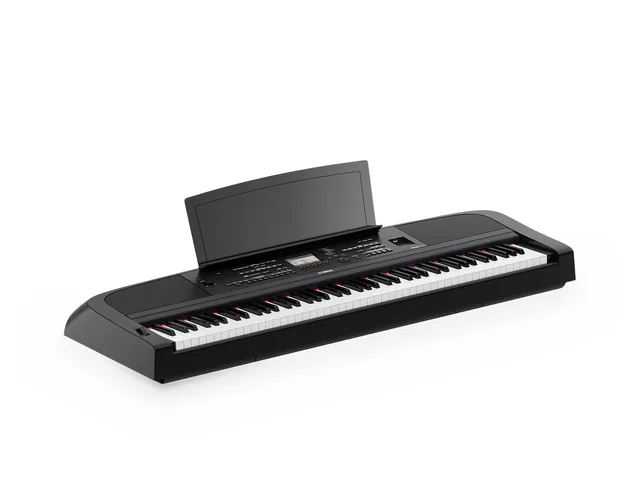
Yamaha DGX-670 — The Worship-Leader's All-in-One


- Angle
- Color display and accompaniment control panel
Features
- Key action
- GHS (Graded Hammer Standard)
- Polyphony
- 256 notes
- Speakers
- 12W (2 × 6W)
- Connectivity
- USB to Host, USB to Device, mic input, AUX IN, one phones/output jack, AUX pedal, pedal unit, Bluetooth audio (varies by country)
- Weight
- 47 lbs (21.4 kg)
- Keys
- 88 fully-weighted
Best for: solo worship leaders, one-person music ministries, and arranger-backed rehearsal or performance. Not for: frequent one-person carrying or teams that need immediate stage-style organ and layer controls.
Read the full review: Yamaha DGX-670
Our verdict
Choose the DGX-670 when the microphone input, arranger styles, and large sound library will be used regularly. Choose the FP-30X or P-225 when the piano action and simpler operation matter more, or the CK88 when a band keyboardist needs faster stage controls. For services, route the DGX-670 through the PA and use its speakers as local monitoring.
Pros
- +Microphone input with reverb, chorus and a Talk mode supports solo-leader workflows
- +630 voices include organs, electric pianos, strings and pads
- +263 accompaniment styles for solo worship-leader practice with band backing
- +256-note polyphony leaves headroom for pedal-heavy hymn arrangements
- +AUX IN and Bluetooth audio (varies by country) play backing tracks through its speakers
- +USB-to-Device records direct to USB stick — useful for service archives
Cons
- –12W speakers are best treated as rehearsal or local-monitor speakers
- –47 lbs is the heaviest pick in this guide — semi-portable, not weekly-easy carry
- –One shared phones/output jack, with no separate left and right line outputs
- –Styles, splits and registrations add menus to learn before a service
- Best for
- Best Overall for Church
- Main downside
- 12W speakers are best treated as rehearsal or local-monitor speakers
How it plays and sounds
The DGX-670 is the strongest all-in-one option here for a solo worship leader. Its microphone input, with reverb, chorus and a Talk mode for announcements, combines voice and keyboard in one instrument, while 630 voices and 263 accompaniment styles cover piano-led services, rehearsal, and fuller arranger-backed performances. The GHS action is suitable for piano parts, though the 47-lb body is better for a semi-permanent setup than frequent carrying. For services, note that it has one shared phones/output jack rather than separate left and right line outputs. See Yamaha's official DGX-670 specifications, and our Yamaha DGX-670 review covers it in full.
View full specs
| Key action | GHS (Graded Hammer Standard) |
|---|---|
| Keys | 88 fully-weighted |
| Piano sound | Yamaha CFX with VRM |
| Polyphony | 256 notes |
| Voices | 630 |
| Microphone input | Yes (1/4-inch; reverb, chorus and DSP effects, Talk mode) |
| Accompaniment styles | 263 (worship, gospel, contemporary, traditional) |
| Speakers | 12W (2 × 6W) |
| Connectivity | USB to Host, USB to Device, mic input, AUX IN, one phones/output jack, AUX pedal, pedal unit, Bluetooth audio (varies by country) |
| Weight | 47 lbs (21.4 kg) |
Take a closer look.
Best Overall for Church
Color display and accompaniment control panel

Best Piano-Led Value

PHA-4 Standard keybed and control strip

Best Budget Church Piano

GHC keybed under the hands
Best Piano-Led Value
Roland FP-30X — The Working Worship Piano
- Angle
- PHA-4 Standard keybed and control strip
Features
- Key action
- PHA-4 Standard with escapement
- Sound engine
- SuperNATURAL Piano
- Polyphony
- 256 notes
- Speakers
- 22W (2 × 11W)
- Connectivity
- Bluetooth Audio + MIDI, USB MIDI/audio, Output L/Mono and R, headphones, sustain in
- Weight
- 32.7 lbs (14.8 kg) with music rest
Best for: accompanists, hymn playing, piano-led contemporary worship, and churches prioritizing action quality. Not for: solo singing leaders who need a microphone input or keyboardists who need extensive live sound control.
Read the full review: Roland FP-30X
Our verdict
Choose the FP-30X for piano-led worship, accompanist roles, and a compact instrument that connects cleanly to the PA. The DGX-670 offers more arranger and vocal features, while the CK88 and PX-S3100 put broader sound options on the panel for a full worship team.
Pros
- +Dedicated stereo line outputs simplify connection to a mixer or DI setup
- +Bluetooth audio and MIDI are useful for rehearsal and app integration
- +PHA-4 Standard action with escapement and Ivory Feel keytops
- +SuperNATURAL Piano sound with 256-note polyphony
- +32.7 lbs is manageable for weekly Sunday setup
- +Compact controls keep piano-first operation straightforward
Cons
- –No microphone input — vocal worship leaders need separate mic+PA
- –56 panel tones vs the DGX-670's 630 voices — more through the app, but less variety at the keyboard
- –No accompaniment styles for solo practice
- –Three-pedal KPD-70 sold separately (it needs the KSC-70 stand)
- Best for
- Best Piano-Led Value
- Main downside
- No microphone input — vocal worship leaders need separate mic+PA
How it plays and sounds
The FP-30X is a strong value choice when the church primarily needs a convincing piano with a responsive weighted action. Roland's PHA-4 Standard keyboard and SuperNATURAL Piano sound suit hymns and piano-led contemporary worship, while 11W x 2 speakers work well for rehearsal and local monitoring. Dedicated left and right line outputs make PA connection more practical than relying on a headphone jack, and Bluetooth audio and MIDI are useful for practice and app control. Our Roland FP-30X review covers it in full.
View full specs
| Key action | PHA-4 Standard with escapement |
|---|---|
| Keys | 88 fully-weighted |
| Sound engine | SuperNATURAL Piano |
| Polyphony | 256 notes |
| Voices | 56 on the panel (incl. organs and EPs), 321 through the Roland Piano App |
| Speakers | 22W (2 × 11W) |
| Connectivity | Bluetooth Audio + MIDI, USB MIDI/audio, Output L/Mono and R, headphones, sustain in |
| Pedal | DP-2 included; KPD-70 3-pedal optional with half-damper |
| Weight | 32.7 lbs (14.8 kg) with music rest |
Best Budget Church Piano
Yamaha P-225 — The Current Compact Yamaha Pick
- Angle
- GHC keybed under the hands
Features
- Key action
- GHC (Graded Hammer Compact)
- Polyphony
- 192 notes
- Speakers
- 14W (2 × 7W)
- Connectivity
- USB to Host, AUX OUT L/L+R and R, two headphone jacks, sustain and pedal-unit connections, Bluetooth audio (varies by country)
- Weight
- 25.4 lbs (11.5 kg)
- Keys
- 88 fully-weighted
Best for: piano-led services, recurring setup, Yamaha-focused buyers, and churches with an existing PA. Not for: solo singing leaders who need a mic input or worship teams needing extensive live sound controls.
Read the full review: Yamaha P-225
Our verdict
Choose the P-225 when the church needs a current, compact Yamaha focused on piano sound and uncomplicated operation. It is a better fit for a pianist feeding the house PA than for a keyboardist switching constantly among organs, pads, and synths. Compare the current listing against the FP-30X before buying because street prices can change the value calculation.
Pros
- +Current Yamaha model with compact GHC weighted action
- +CFX piano voice suits hymns and piano-led accompaniment
- +Dedicated left and right AUX outputs for a mixer or DI workflow
- +192-note polyphony handles pedal-heavy hymn arrangements
- +25.4-lb body is manageable for recurring setup
- +A footswitch is included; the FC3A half-pedal and LP-1 pedal unit are optional
Cons
- –14W speakers are intended for practice or local monitoring, not sanctuary coverage
- –No microphone input — separate vocal mic+PA required for singing leaders
- –24 voices is minimal next to PX-S3100's 700 or DGX-670's 630
- –Few panel sound controls compared with the CK88
- Best for
- Best Budget Church Piano
- Main downside
- 14W speakers are intended for practice or local monitoring, not sanctuary coverage
How it plays and sounds
The P-225 replaces the discontinued P-125 as the current compact Yamaha piano in this guide. Its Graded Hammer Compact action and Yamaha CFX piano voice make it a straightforward choice for hymns, accompaniment, and piano-led worship. The 24 voices and 192-note polyphony cover essential layers without turning the instrument into a workstation, while dedicated AUX outputs provide a cleaner route to the church PA. Yamaha USA lists Bluetooth audio (it varies by country: look for the Bluetooth logo on the panel). Our Yamaha P-225 review covers it in full, and our best Yamaha digital pianos guide has more Yamaha options.
View full specs
| Key action | GHC (Graded Hammer Compact) |
|---|---|
| Keys | 88 fully-weighted |
| Main piano voice | Yamaha CFX concert grand |
| Polyphony | 192 notes |
| Voices | 24 (incl. organs, EPs, strings) |
| Speakers | 14W (2 × 7W) |
| Connectivity | USB to Host, AUX OUT L/L+R and R, two headphone jacks, sustain and pedal-unit connections, Bluetooth audio (varies by country) |
| Included pedal | Footswitch (FC3A half-pedal sold separately) |
| Optional pedal unit | LP-1 |
| Weight | 25.4 lbs (11.5 kg) |
Most Versatile for Worship
Casio PX-S3100 — The 700-Tone Worship Versatility Pick


- Front
- Performance controls and touch surface
Features
- Key action
- Smart Scaled Hammer Action Keyboard
- Sound engine
- Multi-dimensional Morphing AiR
- Polyphony
- 192 notes
- Speakers
- 16W (2 × 8W)
- Connectivity
- WU-BT10 Bluetooth Audio + MIDI adapter included, USB, line outputs
- Weight
- 25.1 lbs (11.4 kg) without batteries
Best for: varied service formats, portable multi-sound use, and music directors who value rhythms and a large tone library. Not for: solo singing leaders who need a microphone input or players wanting dedicated drawbar-style controls.
Read the full review: Casio PX-S3100
Our verdict
Choose the PX-S3100 when portability and a broad sound library matter more than stage-keyboard-style controls. It gives a pianist more arranger and tone options than the P-225 or FP-30X without the DGX-670's weight. The CK88 remains the stronger choice for a band keyboardist who needs faster organ, split, and layer control during a set.
Pros
- +700 onboard tones — widest worship voice library in this guide
- +Pitch bend wheel for synth and lead articulation
- +Included wireless adapter adds Bluetooth audio and MIDI
- +Slim cabinet and roughly 25-lb weight suit recurring setup
- +Dedicated line outputs support a mixer or DI workflow
- +Split and layer modes built in for piano + pad worship leadership
Cons
- –No microphone input — separate mic+PA required for singing leaders
- –16W speakers are best used for rehearsal or local monitoring
- –About two hours on AA batteries, by Casio's figure
- –700 tones and 200 rhythms mean more menus to learn before a service
- –SP-34 three-pedal unit sold separately
- Best for
- Most Versatile for Worship
- Main downside
- No microphone input — separate mic+PA required for singing leaders
How it plays and sounds
The PX-S3100 combines a slim weighted-key design with 700 tones and 200 rhythms, giving a music director more sonic range than a piano-first portable. Its pitch-bend wheel is useful for synth and lead articulation, while split and layer modes support piano-and-pad combinations. The included WU-BT10 adapter adds Bluetooth audio and MIDI convenience, and dedicated line outputs support a wired PA setup. It also runs on six AA batteries, for about two hours by Casio's figure. Our Casio PX-S3100 to PX-S7000 review compares it with the bigger Privias, and our best Casio keyboard pianos guide covers the wider range.
View full specs
| Key action | Smart Scaled Hammer Action Keyboard |
|---|---|
| Keys | 88 fully-weighted |
| Sound engine | Multi-dimensional Morphing AiR |
| Polyphony | 192 notes |
| Voices | 700 |
| Rhythms | 200 |
| Pitch bend | Yes (dedicated wheel) |
| Speakers | 16W (2 × 8W) |
| Connectivity | WU-BT10 Bluetooth Audio + MIDI adapter included, USB, line outputs |
| Batteries | 6 AA (about 2 hours) |
| Weight | 25.1 lbs (11.4 kg) without batteries |
Best Premium Church Piano
Roland FP-60X — The Premium Worship-Leader Pick


- Angle
- Panel with music-rest tablet
Features
- Key action
- PHA-4 Standard with escapement
- Sound engine
- SuperNATURAL Piano
- Polyphony
- 256 notes
- Speakers
- 26W (2 × 13W), speakers in a speaker box
- Connectivity
- Bluetooth Audio + MIDI, USB MIDI/audio, Output L/Mono and R, mic input
- Weight
- 42.6 lbs (19.3 kg) with music rest
Best for: serious piano-led worship, semi-permanent stages, and singing players who want a mic input. Not for: frequent one-person carrying or teams that need workstation-style organ controls.
Read the full review: Roland FP-60X
Our verdict
Choose the FP-60X when a piano-led worship setup benefits from more controls, more tones, a microphone input, and stronger local monitoring than the FP-30X. It is heavier than the compact choices, so it makes the most sense on a stage where it can remain set up or move only occasionally.
Pros
- +PHA-4 Standard action supports serious piano-led worship
- +26W speaker system provides useful rehearsal and local monitoring
- +Built-in microphone input with compressor, doubling and echo for singing worship leaders
- +DP-10 sustain pedal is included
- +SuperNATURAL Piano sound and 358 tones cover piano-led services well
- +Dedicated line outputs support PA connection
- +Bluetooth audio + MIDI for rehearsal and app integration
Cons
- –42.6 lbs is in semi-portable territory — weekly carry is real effort
- –Voice count (358) lower than DGX-670 (630) or PX-S3100 (700) for varied worship sets
- –Three-pedal operation requires the optional KPD-90 or RPU-3
- Best for
- Best Premium Church Piano
- Main downside
- 42.6 lbs is best left set up rather than carried weekly
How it plays and sounds
The FP-60X adds a stronger control surface and speaker system to Roland's piano-focused portable format. It uses PHA-4 Standard action with SuperNATURAL Piano sound, provides 358 tones, and includes a microphone input, with compressor, doubling and echo effects, for a singing player. The 13W x 2 speakers are useful for rehearsal and local monitoring, while dedicated left and right outputs carry the instrument to the PA. The included DP-10 is a single sustain pedal; a three-pedal setup requires an optional compatible unit. See more Roland choices in our best Roland digital pianos guide.
View full specs
| Key action | PHA-4 Standard with escapement |
|---|---|
| Keys | 88 fully-weighted, synthetic ebony/ivory tops |
| Sound engine | SuperNATURAL Piano |
| Polyphony | 256 notes |
| Voices | 358 (incl. premium drawbar organs) |
| Microphone input | Yes (compressor, doubling and echo effects) |
| Speakers | 26W (2 × 13W), speakers in a speaker box |
| Pedal | DP-10 sustain pedal included; optional three-pedal unit |
| Connectivity | Bluetooth Audio + MIDI, USB MIDI/audio, Output L/Mono and R, mic input |
| Weight | 42.6 lbs (19.3 kg) with music rest |
Best for Traditional Worship
Kawai ES920 — The Hymn-Heavy Worship Pick


- Front
- Four-band EQ faders and panel
Features
- Key action
- Responsive Hammer III (let-off, counterweights, triple sensor)
- Sound engine
- Harmonic Imaging XL
- Polyphony
- 256 notes
- Speakers
- 40W (2 × 20W)
- Connectivity
- Bluetooth Audio (aptX) + MIDI, USB to Host and to Device, MIDI in/out, Line In, Line Out, headphones
- Weight
- 37.5 lbs (17 kg)
Best for: traditional/liturgical church-music contexts, hymn-heavy worship services, choir accompaniment, classical-piano-leadership churches. Not for: contemporary worship leaders needing voice variety (PX-S3100) or singing worship leaders (DGX-670 or FP-60X have mic input).
Read the full review: Kawai ES920
Our verdict
Choose the ES920 when acoustic-piano character, hymn accompaniment, and strong local monitoring matter more than a large sound library. The DGX-670, PX-S3100, and CK88 are better choices when the keyboardist regularly moves among organs, pads, synths, and arranger functions.
Pros
- +40W speaker system gives the strongest local monitoring in this guide
- +Harmonic Imaging XL piano sound with 256-note polyphony
- +Responsive Hammer III action with let-off and counterweights
- +Line inputs and outputs and 5-pin MIDI support church-audio integration
- +Four-band EQ faders adjust the tone to the room
- +37.5 lbs is still portable for weekly Sunday setup
Cons
- –No microphone input — separate mic+PA required for singing leaders
- –Bluetooth audio is better reserved for rehearsal than critical live playback
- –38 sounds — fewer than the arranger-style picks for varied contemporary sets
- –Three-pedal unit (F-302 or GFP-3) sold separately
- Best for
- Best for Traditional Worship
- Main downside
- No microphone input — separate mic+PA required for singing leaders
How it plays and sounds
The ES920 is a piano-first choice for traditional services, hymn accompaniment, and choir work. Kawai pairs its Responsive Hammer III action (let-off, counterweights and a triple sensor) with Harmonic Imaging XL, 256-note polyphony and 38 sounds, while the 20W x 2 speaker system provides strong rehearsal and local monitoring. Bluetooth audio (with aptX) and MIDI are both supported, and line inputs and outputs and 5-pin MIDI help integrate the piano with other church audio equipment. It replaces the ES520 in this guide: Kawai America now lists the ES920, ES120 and ES60 in its ES series, and Amazon US lists the ES520 only in white. Our Kawai ES920 review covers it in full, and our best Kawai digital pianos guide has more Kawai models.
View full specs
| Key action | Responsive Hammer III (let-off, counterweights, triple sensor) |
|---|---|
| Keys | 88 fully-weighted |
| Sound engine | Harmonic Imaging XL |
| Polyphony | 256 notes |
| Voices | 38, plus a 100-style rhythm section |
| Speakers | 40W (2 × 20W) |
| Connectivity | Bluetooth Audio (aptX) + MIDI, USB to Host and to Device, MIDI in/out, Line In, Line Out, headphones |
| Pedal | F-10H damper included; F-302 or GFP-3 three-pedal optional |
| Weight | 37.5 lbs (17 kg) |
Best for Worship Teams
Yamaha CK88 — The Stage-Ready Worship Team Pick


- Angle
- Overhead CK88 control surface and weighted keybed
Features
- Key action
- GHS (Graded Hammer Standard)
- Polyphony
- 128 notes
- Speakers
- 12W (2 × 6W)
- Connectivity
- A/D input L/Mono and R (line or dynamic mic), Output L/Mono and R, USB audio/MIDI, MIDI in/out, Bluetooth audio (varies by country)
- Weight
- 28.9 lbs (13.1 kg)
- Keys
- 88 fully-weighted
Best for: worship bands, multi-sound keyboardists, stage splits and layers, and teams using organ and pad textures. Not for: pianists who want the simplest possible interface or the most acoustic-piano-focused experience.
Read the full review: Yamaha CK88
Our verdict
Choose the CK88 when a worship-team keyboardist needs to change sounds, layers, and organ settings quickly during a live set. Piano-first players may prefer the FP-30X, P-225, FP-60X, or ES920, but those models do not offer the same direct stage control. Connect the CK88's main outputs to the PA and treat its built-in speakers as rehearsal or local-monitor tools.
Pros
- +Fast front-panel control of piano, organ, pad, split, and layer combinations
- +Drawbar-style organ controls suit traditional and contemporary worship
- +363 sounds cover broad worship-team keyboard duties
- +A/D input for a dynamic mic or a line source, plus dedicated outputs
- +28.9-lb body is portable for an 88-key stage keyboard
- +Battery operation supports rehearsals and off-grid events
Cons
- –Stage-keyboard workflow is more complex than a piano-first portable
- –128-note polyphony is lower than several piano-focused picks
- –12W speakers are for rehearsal or monitoring, not sanctuary coverage
- –Bluetooth audio should not replace a wired live playback path
- –No pedal in the box: a sustain pedal is an extra purchase
- Best for
- Best for Worship Teams
- Main downside
- Stage-keyboard workflow is more complex than a piano-first portable
How it plays and sounds
The CK88 is the stage-focused option in this guide. Its front panel provides immediate control over three sound parts, splits, layers, effects, and drawbar-style organ settings, so a worship keyboardist can move from piano to organ and pad combinations without deep menu navigation. The library contains 363 sounds, and the A/D input (for a dynamic mic or a line source) and left/right outputs support a band-oriented stage setup. Built-in 6W x 2 speakers are useful for rehearsal or local monitoring, while services should use the main outputs into the PA. Our Yamaha CP88 vs CK88 review compares it with Yamaha's wooden-key CP88, and players considering more performance-focused instruments can also see our advanced digital piano guide.
View full specs
| Key action | GHS (Graded Hammer Standard) |
|---|---|
| Keys | 88 fully-weighted |
| Sounds | 363 |
| Polyphony | 128 notes |
| Live controls | Three parts, split/layer controls, drawbar-style organ controls, effects |
| Speakers | 12W (2 × 6W) |
| Battery operation | 8 AA (up to about 5 hours on rechargeables, 3 on alkaline) |
| Connectivity | A/D input L/Mono and R (line or dynamic mic), Output L/Mono and R, USB audio/MIDI, MIDI in/out, Bluetooth audio (varies by country) |
| Pedal | None included (FC3A, FC4A, FC5 or FC7 sold separately) |
| Weight | 28.9 lbs (13.1 kg) |
Choosing a Church Keyboard for Your Worship Team
The best keyboard for church depends on who plays it and what the service needs. Most worship teams fit one of three roles, and each points to a different kind of instrument.
Read more: the pianist who accompanies hymns and songs, the worship leader who plays and sings, the band keyboardist, the best keyboard for a small church
The pianist who accompanies hymns and songs
A digital piano with a good weighted action and dedicated line outputs: the Roland FP-30X or Yamaha P-225, or the Kawai ES920 when a stronger built-in speaker system helps the player hear themselves. These keep the controls simple, so a volunteer pianist can switch on and play.
The worship leader who plays and sings
A mic input lets one person run voice and keyboard from one instrument. Among these picks, the Yamaha DGX-670 (with accompaniment styles), the Roland FP-60X and the Yamaha CK88 have one. Roland's FP-E50 also pairs hammer-action keys with styles and a mic input; our Roland FP-E50 review covers it.
The band keyboardist
For a worship band that moves between piano, organ and pads mid-song, the best keyboard for worship is usually a stage keyboard. The CK88 gives three parts, quick splits and layers, and nine drawbars; the Casio PX-S3100 is the lighter middle ground, with 700 tones and a pitch bend wheel. Our best stage pianos guide covers more stage instruments.
The best keyboard for a small church
Small churches usually need one instrument that a rotating group of volunteers can play, connected to a modest PA. A piano-first portable with line outputs, such as the P-225 or FP-30X, covers most services. If there is no PA, the ES920's 40 W speaker system is the strongest built-in sound here, though a PA still gives the room more even coverage. Budget for a stand, a sustain pedal or three-pedal unit, and a DI box if the cable runs are long.
What to Look for in a Church Piano
The specs that matter for a worship piano keyboard are different from the specs that matter for home practice. Here's how to evaluate the picks above against your specific church use case.
Read more: speaker power and venue size, voice variety for worship sets, connectivity for worship technology, portability for Sunday morning, durability and church-budget reality
Speaker power and venue size
Built-in speaker wattage is useful for comparing rehearsal and local-monitor capability, but it does not translate reliably into congregation size. Room shape, acoustics, placement, band volume, and speaker dispersion all matter. For a normal service, choose the instrument for its sound, action, controls, and outputs, then use the church PA for consistent audience coverage.
Voice variety for worship sets
Beyond grand piano, many worship keyboardists need electric piano, organ, strings, and pads. The P-225 and FP-30X keep the palette focused; the FP-60X and ES920 add variety while remaining piano-led. The PX-S3100, DGX-670, and CK88 offer broader multi-sound roles, with the CK88 providing the most direct stage control for splits, layers, and organ settings.
Connectivity for worship technology
Prioritize dedicated audio outputs and confirm how the piano will connect to the mixer, stage box, or DI. Bluetooth is convenient for rehearsal, but a wired path is more dependable for live stems, click tracks, and service audio. USB capabilities vary by model, so verify whether a connection carries MIDI, audio, or both rather than assuming every USB port performs the same job.
Portability for Sunday morning
The P-225 (25.4 lbs), PX-S3100 (about 25 lbs), and CK88 (28.9 lbs) are the easiest recurring-setup choices here. The FP-30X is about 33 lbs and the ES920 37.5 lbs, while the FP-60X (42.6 lbs) and 47-lb DGX-670 are better suited to semi-permanent placement. Include the stand, case, pedals, and cables when judging whether a setup is truly portable.
Durability and church-budget reality
Church instruments may be used by several players and moved more often than a home piano. Compare warranty, return policy, local service access, stand stability, and case protection alongside the instrument price. Also consider whether a digital or acoustic piano better fits the room and maintenance plan, then budget for the accessories a digital piano setup needs.
Setup Guide: Digital Piano in a Worship Setting
Buying the right church piano is only half the equation — setting it up correctly in a worship environment is what makes Sunday mornings work. Here's the practical setup workflow most worship contexts benefit from.
Read more: placement relative to the congregation, PA connection, monitor setup for the pianist, cable management on stage
Placement relative to the congregation
Position the piano so the pianist can see the worship leader, vocalists, and (ideally) the congregation. For piano-only worship, stage-left or stage-right placement at a 45-degree angle to the congregation works best — the pianist sees the worship leader, and any congregational visual feedback. Avoid placing the piano with its back to the congregation; you lose the visual connection that worship pianists rely on for tempo and dynamics adjustments.
PA connection: line out vs miking speakers
Use the instrument's line outputs instead of miking its built-in speakers. Many portable and stage keyboards provide unbalanced 1/4-inch outputs, so a DI box is often useful for long stage runs or for connecting to balanced XLR inputs. Confirm whether the model provides stereo left/right outputs, a mono option, or only a headphone-output fallback before buying cables.
Monitor setup for the pianist
If the room is large enough that the pianist can't hear themselves through the piano's built-in speakers, request a vocal monitor channel from the sound team — either a wedge monitor on the floor in front of the piano, or in-ear monitor support if your church PA supports it. Without a monitor, pianists tend to overplay (because they can't hear themselves) which hurts the worship mix. A small monitor in front of the piano solves this; the pianist hears their own playing back and can adjust dynamics correctly.
Cable management on stage
Use cable ties, gaffer tape, or cable channel covers to keep power, audio, pedal, and USB cables away from foot traffic. Label both ends of recurring connections and leave enough strain relief for pedal and audio plugs. Our digital piano accessories guide covers stands, benches, pedals, headphones, and other setup essentials.
Watch out
Do not size a church sound system from a digital piano's built-in wattage or from a simple attendance threshold. Treat the onboard speakers as practice, rehearsal, or local-monitor tools and have a qualified audio person evaluate the PA, room coverage, DI requirements, and monitoring. Equipment costs vary too widely for a universal package estimate.
Need more help choosing?
Frequently Asked Questions
Common questions about choosing the best digital piano for church worship in 2026 — from speaker requirements to PA setup, voice variety, and the best keyboard for a small church.
How loud does a church piano need to be?
Speaker wattage alone does not determine whether a piano can cover a room. Built-in speakers are useful for practice, rehearsal, local monitoring, or a very small gathering, but a normal service should route the piano through the church PA when consistent sanctuary coverage matters.
Do I need a PA system for a church digital piano?
Plan to connect the piano's line outputs to a mixer or DI box. A DI box is especially useful for long cable runs and for converting an unbalanced instrument signal to the balanced XLR connection commonly used at a stage box. Check the exact output format before buying cables.
What's the best church piano under $1000?
Pricing changes, so compare current listings rather than relying on a fixed threshold. The Yamaha DGX-670 suits a solo worship leader, the Roland FP-30X emphasizes piano action and value, the Yamaha P-225 is the current compact Yamaha piano choice, and the Casio PX-S3100 adds broad sound and rhythm options when its current price fits the budget.
Can one digital piano cover piano, organ, and keyboard pad sounds for worship?
For one-board coverage, prioritize quick access to acoustic piano, electric piano, organ, strings, and pads. The Yamaha CK88, Casio PX-S3100, and Yamaha DGX-670 provide the broadest church-ready palettes here. The Roland FP-60X offers a useful middle ground, while the Yamaha P-225 and Roland FP-30X are more piano-first.
What is the best keyboard for church?
For most churches, a piano-first portable with line outputs, such as the Roland FP-30X or Yamaha P-225, played through the PA. A worship leader who sings needs a mic input (the DGX-670, FP-60X or CK88), and a band keyboardist switching between piano, organ and pads is best served by a stage keyboard such as the Yamaha CK88.
What is the best keyboard for a small church?
One that volunteers can play without training, with line outputs for a small PA: the Yamaha P-225 or Roland FP-30X. If the room has no PA, the Kawai ES920's 40 W speaker system is the strongest built-in sound in this guide. Add a stand, a pedal and, for long cable runs, a DI box.
Shahadat Shahi
Founder of PianoRanked. I research this guide from the makers' published specs — no paid placements, no brand partnerships.